I don't have many friends. I never have. The ones I do have are few and far between, and inevitably, they last for a handful of years at most.
Sometimes I think about how my life must look to others. Transient? Nomadic? Flitting from cause to cause, friend to friend as if the very thought of permanence is damning.
An old friend - an old best friend - once told me that I was unknowable. Unknowable, he said - screamed - in my face. I never really thought about how I must come across to those who know me. Those who enter into any sort of relationship with me do so with the knowledge that reciprocity is not in my nature, and that whatever profound sharing of thoughts and minds occurs - it will be temporary. Invariably one day, I'll leave and I won't come back. I'll move on. Because that's just what I do. I imagine that few individuals would be willing to enter into a friendship with someone who has already seen its end from afar.
I suppose I can understand why many are reluctant to embark upon something so transient. Short-lived. Unknowable. How difficult it must be for an individual to share affection with someone who shares so little of themselves. Those I leave behind think me cruel. That once I have moved on, I no longer care. That I am utterly dispassionate toward the trail of grief I leave behind.
Grief.
Aaron died yesterday. Accidental overdose. I always told that fucking kid to quit mixing his highs. Never did listen to me.
He is - was - a few years older than me, but that doesn't stop me calling him kid. The way he looks - looked - at the world was really a league of its own. Naive. Fascinated. Every breath he took was a wonder. Granted, he was the only person who thought so - his mother was kind of a bitch. We used to run together, and not in that 6 am-Kelloggs-healthy living way, either.
I don't know exactly what it was that we had, but it was good. This rather fucked up mélange of anger and alienation and desperation, expressed platonically like friendship was the only way out. It's funny, because for most people friendship is the goal, not the means. I think we were just both pissed off kids looking for some artefact of society to rip apart.
I was a fucked up kid, and this fact will never change. What's even more fucked up is how utterly un-fucked up the world thought I was. This was perhaps more damaging than any successful charge of juvenile arson or vandalism or animal cruelty could ever be. There's only one thing worse than an angry, destructive kid - an angry, destructive kid who got straight A's and was teacher's pet all the way through junior high. One is easy to fix, another utterly impossible. I'll let you figure that one out.
If I ever had to pick a past friendship that I will likely always remember, it would be Aaron. He was the only friend I've ever had who understood what it is to struggle. To genuinely struggle. To struggle against one's own nature. The two of us got up to some awful shit, but it was always honest. We never felt to the need to hide anything from each other - the sadistic gleam in our eyes; the utter power upon knowing that you are the sole cause of another agent's suffering. We never felt the need to conjure justifications for our actions whose sincerity was intended only for the recipient. We were both fucked up, but we were honest about it. For perhaps the only few short years in my life, I felt vindicated.
I think that this sensation in the pit of my stomach is grief. Granted, I would hesitate to label Aaron anything even remotely resembling conventional friendship. Regardless, I think that what we had was the closest degree of genuine affection either of us were capable of.
In the end, maybe that's all that matters.
I am looking for a fresh start.
I wonder why it is that people idealize and romanticize the idea of starting anew - tabula rasa; clean slate. They're still the same person, they will continue making the same mistakes, no matter where or how far they run.
One can flee to another city halfway across the world; lost amid the gray, gray canvas of nameless faces going nowhere. But the first night he rests, he remembers that the sky is still the same, and the clouds floating by are the same ones as the night before, and the night before, and the night before that.
Nothing really changes. The only thing that changes is that when you awake in your new life, you add another notch to your bedpost, and run again. Except, you tell yourself, this time will be different.
It never is.
An excellent panel discusses the evident trend among Generation Y's teens and young adults - "Emerging Adulthood". A well-rounded discussion with both economists and developmental psychologists exploring why youth today are taking longer to reach "traditional" developmental milestones, whatever those may be (or indeed, if they're even relevant in the 21st century).
I have always been very far removed from my peers, hovering in the periphery of their world, never quite understanding.
Like any other young person has done - and will always do - during this tumultuous period of life, I question what it means to live without context. Oftentimes I feel that I am alone in this search for context, because even the justifications that my peers offer me, I am confused by.
I do not equate context with "meaning". The search for the meaning of life is a clichéd, endless question whose answer will lose all meaning if it is ever found. I leave such a vague quest to the philosophers who are only too aware that their search is self-perpetuating.
Individuals situate themselves in different contexts. They will then judge their behaviors and decisions by this context. The contextual scope of life is different for everyone. Some people situate themselves within a circle of friends and loved ones, and they proceed to live their life for these people. This context is by far the most common, and certainly the most pervasive. But what about those of us who do not live for others?
I find it difficult to understand this concept of living for others. It is inscrutable to me because life is entered and departed alone. Why leave, then, an enduring mark on a world you will leave behind? I am familiar with the notion that individuals experience positive emotions when living for others. However, roughly translated, this would equate to living your life in the pursuit of pleasure.
This Pleasure Principle is not a novel idea, but to me it seems as if this context is much to narrow to adequately be considered a context for existence.
By existential context I refer to the idea of placing oneself within the larger system of which we currently perceive to be the universe. Stop now, to contemplate what the world may be like in 800,000 years. Once one begins to engage in this sort of abstract thought, one realizes that the only certainty he has is that 800,000 years from now, he will no longer exist. What he may do in this lifetime will not be remembered. He thus has no permanence in time; no place in time.
It is not the grief or desperation that one may experience upon knowing that generations of human beings will not know of him. There is less significance in that thought, because such a thought is arrogant and proud. The salient and pressing matter here, is when you situate yourself within this timeline itself, armed with the knowledge that time will go on and on into possible infinity. It is difficult to reconcile myself with the fact that I arose into conscious existence out of mere chance, and the universe would have probably been little different had I not been here to think this thought.
The reality is that our species is nowhere near to discovering our origin. The kinder, commonly religious perspective is that we are the centre of the universe. God created us in his image, and once our species is ended, time is ended. But the probability of this being true is so infinitesimally small, myself being an atheist notwithstanding. How many species have come before us, who thought that they themselves were all that ever have and would exist? How many species will come after us?
To cope with such an idea, I distract myself. I comfort myself with material success and learning, taking comfort in my achievements and the events of the present. This is a very common approach - to situate ourselves with the known world alone and thereby be content with where we are at the present.
I find the very thought of the existence of existence to be obscure at best. There is no way to reconcile oneself with the notion that the existence of anything is unnecessary. Everything we can ever conjure - time, space, matter, energy - exists unnecessarily. This may be, however, a product of our limited understanding of causality.
I do believe that, as a member of the human species, I will cease to exist once death has occurred. It may be that I still exist, but I will have no knowledge of this. I do not believe in a heaven or hell. I believe that upon death, I will simply become unaware of everything that ever was and ever will be.
Even if I was religious however, all conundrums I have now would remain. Consider that I, hypothetically, am a devout Christian. The apocalypse has come, and humanity is destroyed. Naturally I would find myself in heaven, a place of eternal happiness. I find it difficult to understand how my soul could last for eternity. The idea of perpetuality is not something that the human species was built to understand. Perhaps if I was there, in heaven, such concerns would no longer exist. However as a living person, now, I struggle with the idea of heaven or hell where essentially time no longer exists.
And this is what I refer to when I remark upon how my existence lacks context. I am not only insignificant, I am non-existent when one considers the possibility of infinity.
The layperson considers himself to have the authority of permanence. He sires children whom will carry on his genetic material and lifelong ideals, he interacts with people whom will remember him. In every abstract way he will have left his mark on the human species.
I have no doubt of this mark. I am aware that regardless of what I do, I have changed this world in some way. If I had not existed, the universe would be different than it is now. I see no theoretical puzzle in this. What I struggle with is the notion of where my place in the universe is, after the human species has vanished; when every subsequent species that had some memory of humanity has been rendered extinct. The last shard of our mark upon the universe - within the memory of others - has now vanished. In this void of existence, we are no longer merely insignificant. We do not exist enough to even be considered, to even be known.
This perhaps, is the primary reason for which I have yet to discover a context that will make me content for the duration of my life. Once an individual places himself against this backdrop of infinity, every single coping mechanism he has ever conjured is now meaningless. I attempt to construct context within my social circle, but I fail to derive any genuine wisdom from those around me. I suppose it is somewhat self-contradictory, given my opinion of human relations.
I have attempted to construct context out of learning and knowledge. I have always been a scholar at heart, and my immense curiosity affords me some temporary goal; temporary comfort. Nevertheless, the quest for intellectual purity still falls short.
I have attempted to construct context out of some supernatural deity that would offer me absolution. I have toiled endless at my spirituality since I was a child, but still faith eludes me. I find it difficult to hold aloft an ideal against which every shred of my rationality rebels.
The individuals with whom I interact consider me a stable, impressive character. To this fact I am not naive. They consider me a high-functioning, self-actualized, and compassionate individual. Little do they know of my existential rage and apathy. I am not the ideal human specimen that I seem.
That being said, I am above all else persistent. My search will continue.
"This can be a quick one. Don't take too long to think about it. Five books you've read that will always stick with you. First five you can recall in no more than 15 minutes. Tag 5 friends, including me because I'm interested in seeing what books my friends choose."
I could have written here a list of books which are considered "profound" - merely Google them and there are hundreds upon thousands of lists out there sporting big authors and classics - some of which are so convoluted and lengthy and complex and utterly boring that the list maker probably hasn't read it (Ulysses, anyone?).
Some of my most beloved books are transparent in plot, simple in language, obscure in reception, and trivial in reputation. I selected these books not because they are profound, but because they made a profound impact on me. I go through a myriad of books a year, and while I certainly retain the information that I gather over the years, much of the original text is lost in my memory. There are however, a few that stay with me for reasons unknown.
1. Heart of Darkness (Conrad)

Comparatively speaking, compared to the rest of my list, I read this one rather late. I didn't read this until I was 15. I'm not going to say that it changed my life, because what changes lives is not books, but rather, the choices we make walking in the shoes of protagonists. I do not believe that all fiction is worthwhile. Fiction that teaches us nothing is a waste of time - life is too short, and our knowledge of the universe is too limited for us to waste time on trivialities.
Heart of Darkness remains the book most significant to me because it is one of those rare books in which darkness prevails from beginning to end, with no reprieve even beyond the epilogue. There is no hero saving the day, no fairy godmothers, no kindness, no grand revelations about human compassion and endurance. There is just suffocating wickedness and profound cruelty and depravity and horror - utterly ruthless from beginning to end.
The storyline follows Marlow, a colonial sailor headed to Africa looking for work in the ivory trade. As he is traveling toward his work post near the Congo River, he hears more and more praise the closer he gets in regards to a mysterious character by the name of Kurtz. Kurtz, he is told, is the finest specimen of humanity that the so-called "civilized" white West have to offer. The workers deify him - lift him upon a godly pedestal of human civilization, intellect, moral character, and goodness; an "emissary of progress", and a "beacon of light".
The further Marlow sails into the "Dark Continent" of colonial Africa, the brighter grows the praise about Kurtz. He is longer merely a man, but a ghost and a god. As Marlow journeys toward the heart of Africa the reader journeys with him towards what must surely be, finally, a standard of moral conduct that is both selfless and universal. That ideal - that perfect ideal, is the only thing that sustains both the reader and Marlow as he wades through trials and tribulations; arid domains infested with "barbarians" and darkness and evil. To Marlow it has become something greater than a single individual, greater than himself - the redemption of humanity, and it is with that thought in mind that he endures.
The climax of the story - Marlow's anticipated meeting with Kurtz - is ambiguous and unsettling. To this day numerous Conrad scholars debate its meaning. Some are of the opinion that their single conversation is a grand triumph; a victory that burns brightly in the holy dark. Others contend that it was not an immense victory, but an immense defeat - a defeat so grand that there exists no conceivable hope of ever emerging from a state of moral depravity.
To the few Conrad scholars that I have contacted, while most concur that Heart of Darkness is a dense, concise work of genius, few believe that the book's message was anything but celebratory. It was a triumph, that all say. It was "an affirmation, a moral victory paid for by innumerable defeats, by abominable terrors, by abominable satisfactions. But it was a victory!" (Conrad, Ch. 2)
And one may choose to interpret it as such. Victory is always kinder to the victor. I do not discredit anyone if they choose to glean from it a lesson rather than a tragedy, because it is kinder that way.
To me however, the confrontation between Marlow and Kurtz was not kind. Through an investigation of their dialogue, it becomes apparent that Kurtz is not speaking to Marlow, but rather, to Marlow as single specimen of the human race. It is this grander audience that he addresses.
Kurtz is an angry, broken man whose grief has turned inexorably to rage. He is wicked and vile and Conrad saturates his presence with demonic imagery and curt, punctuated sentences as if every word spoken is unnecessary - and it is, it really is. Marlow and the reader alike are in shock and denial - this denial of humanity's true nature continues on after the reader is finished, the story is read, and the day is done.
The title itself (Heart of Darkness) can be interpreted in one of two ways:
a) (The) heart of darkness
b) (A) heart (composed) of darkness.
Clearly, one is kinder than the other. The reader can either choose to identify darkness as an external entity independent of oneself, and therefore the story becomes a journey toward the heart of darkness on earth - a story of bravery and nobility and conquest.
Alternatively, the reader must reconcile himself with the notion that to discover the heart of darkness, one need only look within.
I greatly admire this book because it makes no judgment on the "rightness" or "wrongness" of our decisions, only the consequences - one cannot fault Kurtz, because to condemn him is hypocrisy. Conrad makes no effort to introduce the concept of moral-immoral duality. Typically, the message of such works of literature emphasize the dual existence of good and evil, and that the existence of one is the necessary and sufficient condition for the existence of the other. I do believe however, that Conrad posits this novel in the form of both a warning and a reminder.
Heart of Darkness is ultimately a work of profound tragedy. The tragedy does not exist in the darkness itself, but rather, in the absence of light. More hopeless than wading through the dark is the notion of darkness without reprieve; a profound cynicism and loss of hope that redemption will ever be possible.
This is an excellent piece of literature, but let's be honest here - it's awesome because it's misanthropic and angry and cynical in such an enormously epic way.
Heart of Darkness = Win.
2. The Bible (by "god", apparently)

I just threw this one in there because it was an interesting read, and it took me 12 years to truly finish. Judeo-Christianity has been such a significant presence in human history, that I felt it deserved my attention by merit of that alone.
Writing style is great, syntax was superb in some areas - particularly the lyrical Psalms. Some of the fairy tales however, lacked character development.
The author should seriously work on that.
3. Catcher in the Rye (Salinger)

Alas, JD Salinger, may your angry, angry, hermit soul rest in peace.
I will be honest in saying that the moral of the novel did not strike me as groundbreaking in some profound philosophical way - there were no Joycean epiphanies or grand revelations about humanity. I do believe that the moral of the story was that life does not have a moral, and we should not live it expecting one to appear.
Ultimately, it made this list because I read it during a pivotal period in my life when I began to eschew conventional morality for my own brand of (admittedly dubious) moral relativism. I met Holden Caulfield during a period of my childhood when I realized that things failed to move me as it did for my peers; there is comfort in solidarity - you cannot be an immoral person if your eyes are blind to the judgments of others. Life is a journey we begin and end alone, so really, who gives a flying fuck what conventional morality has to teach you about being human. Just live life until it's done, then, you're done.
Holden desired to preserve the innocence of children - their sincerity, naivete, and blindness. I am, in many ways, far less noble than him. I'm not sure what to make of that.
I disagree with the notion that "there is a sucker born every minute". First of all, suckers are clearly made by a intellectually-wilted society that demands obedience, not born. Secondly, there are a hell of a lot more suckers created every minute than the statement would suggest.
There are certain individuals who choose to take the moral high ground - whom declare for themselves a responsibility to protect the morally blind. I lack their nobility. I have no issue with stealing from the blind.
4. Without Conscience (Hare, PhD)

I picked this book off the library shelf when I was 11. It was newly published just a few weeks prior. This book spurred my lifelong interest in personality psychology, and I followed Dr. Hare's work all through junior high, highschool, and now into university.
I'll be honest, the book wasn't particularly enthralling. It was far too sensationalized for my taste - a tad too much dramatization and shock value phrasing. That being said, I do understand that often times this is necessary to make learning accessible - accuracy and complexity is often sacrificed when catering to more generalized audiences. Nevertheless, it made this list because it was such a significant moment that shaped the course of my academic and intellectual career.
I have always lacked interest in positive psychology, that is, the psychology of functional, chronically happy people. It is not that I think positive psychology is not a worthwhile pursuit, because it is. It really is. Simply the amount of funding that goes into gifted child psychology, for example, make it worth it, notwithstanding the almost infinite reservoir of research avenues.
The simple fact is that such people bore me. I have no interest in studying sheep.
It is clear that psychopathy fascinates the public. The motivations behind such a fascination are often rooted in fear - fear of victimization, but more critically, fear that their neighbor could be harboring such terrifying people - fear that they are sleeping with the enemy.
Ironically, and curiously, few are interested because they fear becoming one, or of discovering that they are already beyond the point of no return. Such a motivation reeks of judgment, and efforts to distance the self from the abominable at the cost of ignorance.
5. Rule of St. Benedict

I am not a theist. I do not structure my life around a divine entity. I do not pray. That being said, the Rule of St. Benedict is most aptly described as a guide for monastic life.
This piece of writing did not change my life, but it did change my lifestyle. As a secular humanist, to read the Rule of St. Benedict with specifics in mind is foolish and futile. However, there are a great many elements that I do find attractive in monastic living. They have nothing to do with god or living a conventionally "godly" life.
There are 4 things that I structure my life around: silence, gravitas, solitude, and simplicity.
These are elements which are highly congruent with the monastic lifestyle, regardless of divine origins or purpose. Such values are not to be taken literally nor lightly. I have no desire to join the ranks of monasticism, considering that the goal of monasticism is too seek god. Rather, it is the monastic mindset that appeals to me, which I had already adopted long before reading the book.
For instance, silence does not refer to audible silence. To be silent is difficult but not straining - something which can be accomplished by any individual. To my understanding of silence, silence is less about noise and more about the need to create noise. Observing silence is to realize the value of a quiet mind.
Similarly, gravitas affords a certain level of solemnity and poise. It is not to say that life may not be enjoyed, but rather, that life should be taken with some degree of seriousness.
The notion of solitude naturally lends itself to a high regard for simplicity. My bedroom is spartan, my belongings few, and my dresser sparse. To refrain from excessive materialism is not, contrary to popular belief, merely about ridding oneself of things - it is the ridding of the desires which led us to a drive for possession.
There do exist a few minor technicalities which I have adopted or abridged from the Rule of St. Benedict. For instance, while the cornerstone of monasticism is prayer and faith, I have neither, and so see no benefit from the integration of these habits. I do however, adopt the periods of extended silence - hours or days during which I refrain from speaking and am silent.
Moreover, monasticism concerns itself greatly with the notion of detachment - material relations, interpersonal relations, and familial reasons alike. This philosophy I have abided by for years. The Rule of St. Benedict is a religious text from which I gleaned a holistic mindset, rather than specific monastic rules. To this day, secular monasticism remains my life philosophy of choice.

I forget that people actually engage in relationships beyond what I am familiar with. It seems like something people take for granted; that I take for granted. This is the problem with spending so much of one's time in solitude - you only see a small portion of the human experience, and sometimes it can blind you like a bug in a cup. Sometimes it can hit you full force before you have a chance to ready yourself; it can strike out of nowhere, a sudden reminder, and you are sent reeling to the earth gasping for air.
I forget occasionally that my experience is atypical. I have no close relations; platonic or otherwise. Do I wish I had any? I cannot answer that much like a colorblind child cannot truly desire color - what she desires is to conform and to belong, not color. In the same way sometimes I look at people in their loving, compassionate families or couples walking hand in hand and I feel a tug of curiosity.
A tug of puzzlement, and it knocks the wind out of me. It strikes me suddenly, painfully, this curiosity - this realization that I am not the common experience. That everyone around me throws around their platitudes and endearments as I do, but they mean it. They mean it in a way I may never understand.
I do believe part of it is fear. I am scared. There is little I genuinely fear in this comprehensible universe, and of the few things I do fear one of them is the unknown. It is a primitive reaction - the caveman who is conditioned to fear the dark and of being in a situation for which he lacks sufficient knowledge or preparation.
In a critical sense I have never been a child, but this is a primitive, childish fear that I identify. I fear to enter the world of the common experience, I fear becoming ensnared in such complex intimate relations, I fear that one day I may longer be able to view the universe in this detached, objective manner that I am capable of now. I fear that one day I will find myself in such a relation, and that I would lose my identity, my focus, my quest for truth.
I am a scientist, above all else. A scientist of human understanding. It is the only thing I have ever had, and I will fight to maintain this objectivity to my dying breath because if I lose this last shred of detachment - the only thing that I truly own - then I will be left with nothing.
If ever I am in such a state of profound intellectual grief, there will be embarked upon a legacy of parallel destruction. It would be the point of no return.
"When I was a child, I talked like a child, I thought like a child, I reasoned like a child. When I became a man, I put childish ways behind me. Now we see but a poor reflection as in a mirror; then we shall see face to face. Now I know in part; then I shall know fully, even as I am fully known." (1 Corinthians 13:11-12)
I am not a religious individual. I once thought myself truly devout, but those days are long past. I remember when I was a child, that my dream was to be known. I do not need to be loved, I remember telling my mother during a late-night confession involving cookies and 4th grade science projects. I remember telling her in my 8-year-old grasp of the English vernacular, that love to me is not necessary in order to be known. To be known, one only has to be feared.
My mother has never been an astute woman, but she makes up for in effort what she lacks in competence, and I cannot fault her for that. In retrospect, as I relive that moment in my current memory, it was fear that I saw in her gaze. Fear and confusion and a solemn spark of something dangerous, for surely she cannot have birthed a child that was so utterly devoid of human understanding.
- But that means you will go jail. Do you want to go to jail?
I thought that was very clever of her; surprisingly clever. What does a child understand of criminal repercussion? What can a child understanding of imprisonment - of lost time - as punishment, if to her death is still an abstraction and she has all the time in the world?
I am not a child anymore. There is a tradition that upon passing 20 years of age a child becomes an adult - capable of their own fate and their own consequences. To the world I am incredibly young still; they think me naive, inexperienced, a youth acting on an adult stage. To a great extent this is true, for all intents and purposes the adult world still views my peers and myself as children still. But among the children, they sense it, they smell it - no longer one of them, and it is only among children am I not a child.
My mother never quite mentioned that night again, as is her wont. My biological family is incredibly dysfunctional, of this we are not naive. It is a tense conglomeration of repression and denial and avoidance and of running away from problems one cannot hope to solve or find solace from. My mother is frugal by nature - a quality whose most extreme manifestations I have inherited, and as such, she does not believe in lighting or in heating bills. It is rather poetic then, that the temperature and lighting in our family home so bellies the frigidity and judgment and coldness in our relations.
There is one thing I will never understand and is, in truth, partly the motivation behind years of curiosity and academic pursuit. This enigma is my older brother. We share half of our genetic material, and a nearly identical rearing environment. Yet our hopes, our anxieties, our vices, and our demons are so polar, it is as if we never met until the day we die.
I have hypothesized on it extensively. My brother by nature has a congenial, warm temperament and genuinely enjoys the company of others. There was very little competition between us by virtue of our vastly differing priorities and abilities. In the face of incompetent parenting, he sought love and belonging in his peer group, and found it. In the days of Christian youth groups and highschool parties, our house was always filled every weekend with his impromptu barbecues and functions and get-togethers. In time, he managed to connect with our father and maintains a solid, if not loving, relationship with him.
Both my brother and I were raised in a church - in theory it should have been an incredibly protective factor. Our connections to the church community were extensive and longstanding. We had both begun as toddlers, and the community had essentially watched us grow and blossom before their eyes. We were both "headed somewhere in life", expected to make something extraordinary of ourselves in God's world. We were youth leaders, role models for younger peers, the kind of kids whom parents of other children at church would point to and remark "you should be more like them". We were the golden siblings in the English congregation; up and coming youngsters destined to be leaders in the church community. I do surmise that had it not been for my contributions by virtue of birth to that church, I would be even more cynical than I am now.
Because there was kindness, there was compassion in that church, but my days there also taught me that while God was infallible, humanity was not. I recognized the church for what it was - a quivering, insecure mass of patriarchal Elders and gossiping housewives and political scheming and power-mongering and hypocrisy. But the social aspect of it was certainly protective, I will not deny that. My elder brother in particular, flourished in church - he found his niche, his belonging there.
I sought comfort through intellect. I dove headlong into encyclopedias and science projects and literature and philosophy and psychology. I swam with Moby Dick and twirled the world of subatomic particles around my fingers; danced with relish in the grand halls of Conrad and Joyce and Kafka and (regrettably) Freud, I walked the streets of Ancient Rome and flew upon golden wings with Icarus and mythological Greek gods, and I studied everything a 12-year-old could amass on developmental psychology and, more heatedly, all the literature I could find on abnormal child development for years and years and years. Needless to say, my social life suffered and I never developed a peer group, never found a group of friends whom I identified as true peers. I never developed a solid understanding of humanity and emotion, I never belonged, only observed. Contemporary psychology would call it a pathological failure to attach to a primary caregiver, but I call it failing to give a flying fuck about humanity.
I am an adamant disciple of the notion that while life is not deterministic, life consists of a few critical decisions - of things done or not done - that determine the entire course of our eighty years. As the years pass I am beginning to realize that I am drawing closer to a decision that could very well condemn me to the ranks of dark humanity. The idea is obsessive and pervasive; I find it difficult to believe that one day I will have to awake and face the consequences of my actions.
I fail to descry any shred of constructiveness or contribution to humanity that my decision could bring. It would be a career of selfishness - of gratification that I can neither justify nor ignore. It would be the taking of what I want from a world that I will offer nothing in return. I am not naive to the moral incompatibility of my actions.
Freud once wrote that if a child could destroy the world, he would. I most definitely would have.
For some individuals, life is a vivacious, extraordinary phenomenon whose novelty will never wane, never so much as falter until the day they die. I never believed my childrens' pastor when she told me that for every child the Lord has a plan, that for every youth the Lord has a path, and that all I had to do was follow his banner.
I do not believe in a god anymore, because more wretched than urban despair is an urban despair that is by necessity, bestowed by god through his inaction. I could never compromise, never make peace with such a cruel master.
I awoke this morning to the sound of youthful cries and shouts that typify mornings at a university dormitory. As I sit here and listen to the same sounds an hour to midnight - my roommates thoroughly inebriated in the next room over - I come to the realization that there is little that is able to move me anymore. Life has become little more than a state, a static moment of existence held aloft and burning only through inertia.
I never possessed a zest for life even as a child, and this apathy trails my every passing day like a lovestruck hound. I compare myself to my peers, to the specimens of humanity I see everyday and I feel as an alien. Their drunken pounding on my dormitory walls, their exclamations of hilarity, their music vibrating the walls - it irritates me, sends an itch down my stomach but also provokes a shameful thrill of sadism.
I am a loner.
It is difficult to explain this to those who are familiar with me at school or at work, because in these contexts I am always outgoing, always quick and talkative, always amiable and eager. This facade is both necessary and expected, and because of its necessity I bear it no ill will. It is simply another duty I perform.
My relationships are superficial at best; I am careful to maintain my distance. There is nothing I fear more in this comprehensible universe than to find myself involved in an interpersonal affair from which I cannot extract myself immediately at will. This perspective, naturally, is not mutual and I am aware that I have alienated many acquaintances as a result.
Contrary to popular belief, this does bother me. I am, in all facets of my life, a ghost, and being the subject of malcontent does not lend itself well to invisibility. Through such collateral affronts, I find that those who remain in my social circle are those who do not place demands upon me which I am unable to perform.
I do have one such friend in mind as I write this, and it is her that this post concerns. She is a year younger than I, but we have been friends since highschool and such trivial differences disappear upon entering post-secondary education. She is kind, and very patient but more importantly she understands that even though I do not actively seek her company, I enjoy her company. This unspoken implication hangs in the air, and it is well met.
Tonight, she hosted a house-warming party to which she invited every friend she holds dear, including myself. The date has been set in advance, and she is aware that I know of its occurrence. She showed up halfway through her party as I sat in the darkness of my room, knocking on my door to update me of its progress and to bring me small confectioneries.
I value this friend because she understands that I am incapable of maintaining any real sort of intimate, human relationship, but that I do regret it, and it is this effort that she tends. She does not fault me for my inadequacies, and does not take offense at my isolation. She made the invitation with open arms and warm smiles, fully knowing that I would not attend.
I am a ghost. I spend the bulk of my life in isolation and silence. I am alone but not lonely, for it is in such invisibility that I find comfort and peace. I am incapable of responding rigorously to the demands of social life - this is a deep inadequacy that I have long come to terms with. I have tried for years to find some measure of peace and purpose in the modern world, in the average existence of a western individual, but I have found nothing in such study. The quietness of resignment is the only solace I have, and I cling to it like a drowning sailor cast adrift into the vastness.
I am the hermit at the foot of the mountain, having shouted and hollered words of early wisdom to the marketplace, but was not heard and so now is silent. I am the quiet gaze that follows anonymous strangers as they make their noisy rounds in the metropolitan rain. I am the friend who fails to ever become more than an acquaintance, out of reach because my phone is off and I do not attend gatherings. I am the conversationalist that enthralls hordes of colleagues, but never seek to reach beyond the intellectual connection - the lecturer, the educator, the entertainer but never the friend.
From an archival perspective, this tendency to leave nothing behind means that I transfer from clique to clique, school to school, and workplace to workplace leaving nothing behind but records of work well done or nameless grades. It may sound inadequate to the average observer, but I view it as a positive quality. Because I am invisible and spiritually homeless, my home is everywhere.
There is a beauty to wandering the urban streets at night, the lights flickering overhead, cars blaring by, adolescents giggling with their schoolmates, a couple enthralled with each other - lost in a world of vibrant possibility and connections yet to be made. There is a beauty in the urban landscape that I will never be able to articulate sufficiently. As the Gregorian chants register quietly through my earphones - a black figure dwarfed amongst buildings of human grandeur and monstrosity, I feel small as my boots walk the streets that have been walked by hundreds of thousands of unnamed feet.
I am humbled by such grace, and slip back into the city.

Hotchner: You were just responding to what you learned, Vincent. When you grow up in an environment like that, an abusive and violent household.. it's not surprising that some people grow up to become killers.
Vincent: Some people?
Hotchner: What's that?
Vincent: You said some people grow up to become killers.
Hotchner: ...And some people grow up to catch them.
(Criminal Minds - 1x08)
I've always been fascinated by criminology. So much effort and national resources are put into apprehending criminals, and so little into preventative measures. This disproportion seems irrational to me.
What interests me is the distinction between criminality and potential criminality. In theory they are somewhat indistinguishable, but in practice their difference can span a lifetime. By "criminals", let me exclude the lesser crimes - petty theft, lesser assault, and misdemeanors. It would also be useful to exclude motivations which are more or less universally understood: monetary gain, simple vengeance, or passion. What is left is what our society currently labels motiveless and sadistic; not understood and therefore abominable.
Suppose a pair of siblings are reared in such a way as to closely match the FBI checklist of environmental/behavioral risk factors for serial murder: abusive father, domineering mother, separation from primary caregiver before age 5, dysfunctional/abusive and often violent home environment, emotionally invalidating parents, chronic low self-esteem, social isolation, previous suicidal ideation, repressed rage, pyromania, extreme cruelty to small animals during childhood/adolescence, lack of empathy, emotional callousness, record of substance abuse or pathological psychiatric history. Let us further suppose that these siblings also happen to fall into a certain subset of the general demographic into which organized serial murderers often fall: male, above-average intelligence, employed in a white-collar occupation, owns a vehicle, married with children.
Given the environmental factors and behavioral signs, it is also highly likely that these siblings may show early signs of psychopathy during early childhood. Suppose no intervention is made, and their personalities are firmly cemented in adult life.
The question of fault, then, begins to emerge. The current understanding of the criminal mind in western legal courts is that while traumatic upbringing may lessen punishment, it does not excuse guilt. It is interesting that while a modern day jury will be more sympathetic once presented with abusive family/life histories of a convicted criminal, they will still not allow this information to excuse guilt. This seems to be an inherent contradiction in that while it is acknowledged that upbringing unwillingly shaped a child into a sadistic, cruel murderer, this child is still not excused from responsibility.
And suppose that while one sibling went on to lead a (relatively) ordinary life, the other went on to torture, eviscerate, decapitate, and murder scores and scores of couples who reminded him of his parents. Does the law-abiding nature of the first sibling mean that an abusive upbringing cannot garner sympathy for the second sibling in a court of law? This follows the rationale that, of course, since the first sibling experienced the same abuse and did not become a murderer, upbringing had no bearing on the choices of the second.
It seems clear, but the simplicity of this conclusion must be tested further.
A common response to this dilemna is as follows: "It doesn't matter what he's been through, he made a conscious decision to break the law and therefore must be held responsible".
Care must be taken when deciphering the concept of "conscious decision". While I certainly agree that the criminal is aware of right and wrong, I disagree in that he may be completely coherent in his moral ability to choose compared to another individual. I do not excuse his guilt, but one must sympathize with his compromised moral compass.
The decision to commit serial murder is not a single decision. As Douglas wrote very succinctly: "The creation of a serial murderer begins in childhood." The human child is programmed to adapt to its environment; its very existence is honed to acquire knowledge and change itself so as to best survive in that environment. As such, a child who is reared in a household where it is taught compassion, honesty, integrity, and self-worth will align its morals and later its world-perception to these values. A child who is exposed to abusive parenting, emotional invalidation, inconsistent punishment, and cruelty will "endure, endure, and endure whereupon he will curl into himself. He will learn that people are mere objects; he will be incapable of empathy or conscience, and at the very deep-sated core will be a child of intense, repressed inner rage." (D., 2001).
Is it the child's fault if he grows into a remorseless, sadistic adult? Should he be punished for any action he takes on its behalf?
Or perhaps the interesting question still remains: how different, really, is the first sibling from the second? If both share fundamentally the same personality and experiential characteristics, what difference does it make that one acted upon it and the other did not? Is the first sibling merely more competent at repressing his sadistic, homicidal urges? Will it emerge later in life? How much fault should be placed on the criminal if his "conscious decision" was indeed conscious, but shaped by other factors and variables beyond his conscious control?
Western individuals are quick to place the blame solely upon their "monsters", but perhaps only because they are afraid to admit that it is because they created these monsters. They are so quick to create an abomination out of phenomenon they cannot understand; so quick to shift the blame from themselves. A child raised in a compassionate, moral environment does not grow into a moral wasteland of an adult.
Afterall, as Carl Jung once wrote: “The healthy man does not torture others - generally it is the tortured who turn into torturers."

I am a student; one youthful mind against a universe that is all too ready to patiently teach me my imperfections - a universe that is swift to anger and slow to forgive.
I initially had a great deal of difficulty selecting my specialization for post-secondary study. It was not that I enjoyed every potential discipline, but that my holistic understanding of truth would not permit me to attempt a lifelong career of academia while fully aware that the nature of knowledge is such that to overlook a single element is to err. As of this writing, I am currently pursuing a double specialization in Research Psychology and Computer Science.
To every mind, they are apparently polar opposites in discipline, in technique, in method, and in philosophy of understanding the world and its inhabitants. They appeal to me because whereas one discipline represents a world that I intuitively understand, the other represents a world in which I am seemingly born colorblind; rudderless and adrift without any real control condition to which I can compare my findings.
The particular area of research I have been involved in for several years is the study of dark personalities (narcissism, psychopathy, and machiavellianism), more specifically in the psychopathic continuum and its applications to the forensic population. I am not a diagnosed psychopath, but I share with this minority population a profound absence of emotional understanding, and the subsequent compensation we must utilize to stay afloat. Even though I cannot identify with their lack of fear and impulsivity, I find a kinship in our mutual opinion of emotional motivation as opaque and unknowable.
Whereas general society frowns upon psychopathy as a choice comparable to criminal behavior, it is not always so simple. Consider that much of psychopathic manifestations occur as a result of compensation for inborn deficits; an effect of an organic cause. If a child has no understanding of the emotional motivations behind average human behavior, then he must discover an alternate methodology for interpreting social situations, not limited to rationalization, intellectual study, observation, and experimentation. People become to him not people but objects, objects whose state of existence goes unquestioned but not unnoticed.
An individual with deficient emotional experience would also, conceivably, lack the barriers to self-actualization which in much of humanity is a source of restraint. If this individual does not experience love, then they are incapable of reciprocity. Likewise, if this individual does not experience guilt, then what is to stop him from manipulating people in his circle of influence, from committing theft without thought, from torturing animals as a child, or from reveling in the pain of others?
Dark personalities may be merely interpreted as a dimension of intensity - all of humanity is narcissistic, psychopathic, and machiavellianist but the diagnostic criteria for research purposes set aside a minority population who take these characteristics to extremes.
Consider also that serial homicide offenders, a large portion of whom exhibit signs of schizoid and psychopathic personality, are also a result of their rearing environment. Although childhood abuse is not a predictor of later serial homicide or psychopathy, it is overwhelmingly significant. Nearly every single incarcerated or executed serial homicide offender in the FBI database have histories of physical, sexual, or psychological abuse.
It is not difficult to imagine that, given decades of negative environment coupled with social isolation and peer rejection which invariably follows from a lack of empathy, this absence of emotional understanding can be a slippery slope toward the development of a dark personality.
I recently returned from a youth leadership camp, in which one group activity involved sharing our personal testimony and perspective. I was asked to describe my perspective on human interaction. I proclaimed that I found humanity much too interdependent than the existing justification for being so - survival via social cohesion. This interdependency beyond mere sharing of resources is not something that I intuitively understand. Likewise, there are many facets of human interaction that I am only now competent in because I have spent years of quiet observation and study.
Understandably, they did not fully understand, so I endeavored to illustrate by example.

You are at your uncle's funeral, I presented. You are a small child, and all around you the adults are quiet. Your aunt is sobbing into your mother's shoulder; broken, dry gasps under her veil, but all that occurs to you as you watch them is how uncomfortable it must be to have someone cry into your neck. All that occurs to you is what self-restraint your mother must have in order not to push her away in disgust as the saline dribbles down her blouse.
Your second uncle is standing rigidly as the coffin is lowered, and he does not so must as twitch or sway. It is thirty-seven degrees centigrade and he is wearing his black, thick wool navy uniform complete with white-vested cap, but you look at him and giggle because, finally, here is another person who does not understand why people are weeping at a funeral. Here is another person who does not understand why another person's death causes a community to grow silent and somber.
He lowers his gaze and frowns at your celebratory grin. You are are gruffly told to respect the dead. It then occurs to you at that moment that you are alone, that he is yet another gray member of the city that weeps at funerals. To respect the dead it seems, to you, is futile, but you remain silent.
To avoid reproach and punishment, at future funerals you always shed tears and give platitudes. You spend the next decade blending into the emotional majority in an intricate dance of complex mimicry and forced substitution. You have become an excellent student of conventional moral and emotional conduct, although they exist to you at an intellectual level. You confuse goodwill with avoidance of punishment, and you confuse compassion with social reputation. To you these internal and external motivations are one and the same, but as time progresses you come to the realization that you are different, that while the world turns and people experience love, joy, and empathy you remain stagnant - such things but mere abstractions. As the next decade approaches, you become embittered. You begin to utilize your studies in malevolent manipulation, your absence of remorse leads you into antisocial behavior and criminality. At thirty years of age, the judge finally sentences you to life imprisonment, and as you plead your case - childish need for belonging, you are rejected and begin to harbor a profound, deep-sated rage.
I do not doubt that this child made poor decisions, but every individual makes poor decisions. It is humbling to think that within 1% of the population (Hare, 1989), is the capacity for intense malevolence. This lack of complete emotional experience may begin with an organic precursor - a genetic predisposition, and when coupled with peer rejection and parental abuse, is a dangerous combination of inability to identify with others, sadism, and a fiery foundation of rage. Is the child himself to blame, even when so many formative factors were beyond his control? An absence of much needed intervention, as stated by the criminal justice system, explains but does excuse poor decisions, but we must remember the child.
We must remember the child.
Joseph Conrad once wrote, controversially, that "we live as we dream - alone" (Heart of Darkness, 1899). The public malcontent that arose from this proclamation was not one of disagreement but denial, for as much as humanity values interpersonal constructs such as love, compassion, and unity, such things are not in his nature. Society I believe, is too interconnected to a point where the greatest good is sacrificed for the common good. The protesters and lobbyists forget that as we enter this world bloody, unwilling, at the enormous physical pain of another human being, and ultimately alone, so we will also leave it alone.
The city is never quiet, never solemn, never still. The insignificant suits and ties that line its capillaries and infest its streets never quite stop screaming. They go at it day and night, never quite pausing long enough to contemplate, even for a minute, the fact they are scurrying about furiously to please a 9 to 5 boss whom will never return the favor. It's pathetic, but more than that, it fascinates me at an intellectual, academic level. The study of darkness is a pursuit I hold close to heart.
With that in mind, two weeks ago I engaged in a 5 day period of silence. It was not a particularly extended period of time, as my current record stands at 11 days two years ago during Christmas break.
It was a period in which I did not speak, and endeavored to be as silent as possible in routines and habits. The monastic life, one which values humility, introspection, and silence, is a close approximation to the experience. From the perspective of practicality, I am unable to indulge this practice beyond school vacations as often as I'd like, as many a time academic and professional obligations require reentry into the world of urban noise.
The 5 and 11 day periods of silence were not difficult, as I am an individual well accustomed to being a ghost. It is a reaction I know well, like a dear friend who was never quite everything you ever wanted, but are satisfied with because the rest of the world confuses you.
For the average western individual, I imagine such a practice would be insurmountably difficult in ways in which I am unrestrained. I lack any intimate relations, platonic or romantic, and have a superficial social circle who are all, in some manner, invariably linked to my professional and academic life. In my daily discourse the rule of silence is not a rule, but rather, an observation.
Silence is a practice which entered my life with minimal effort - the result of a state which, to me, occurs naturally and without thought. I discovered as a child that if I let the urban noise surround me, I become invisible. To be a ghost is to walk the streets in the city rain, anonymous and adrift - the blessing of quiet observation and silent grace.
In all honesty, the city night is the only thing in this comprehensible universe which is able to afford me some small measure of comfort. I am unseen but felt, for accompanying a natural state of invisibility is the natural state of observation.
The gray man in this gray city passes by me without a glance.
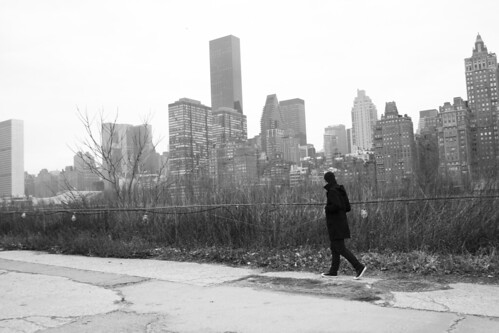

I haven't spent much time in my childhood suburb as of late, since I've relocated to the adjacent Vancouver metropolis for school. I haven't genuinely walked the streets and weaved through shortcuts as only a native can, in a very long time. Realistically it's only been a year, perhaps less, but I am young and in one's days of youth a year is a lifetime.
I look at the streets differently now, much more differently than I did as a child. Somehow home never looks the same when you return following a period of maturation. It doesn't feel like home anymore, not like it ever did, really. Even the shortcuts learned when skipping school or exploring with classmates feel foreign; alien. I felt like an intruder, like the intimacy of these streets that no non-local should ever know about were unwillingly and unwittingly passed onto me by some accidental chance.
I felt like a shadow, one whose time has past and was clinging onto some remnant of nostalgia. I see no one on the streets that I recognize, and so many stores and buildings have changed - not significantly, but enough - that I would look upon an intersection and not remember what memories I made there.
I suppose this emotion would be described by people as grief. It doesn't chill my body like it would for others, but there is something ringing intermittently there that tells me the time to move on is nearing. One day, soon, I will leave this city and never return. As I walked again on the deserted weekday streets, it struck me that this must have been how the ancient Romans felt as they watched their empire fall into decay. It happens almost imperceptibly - an overgrown temple, fading marble, and abandoned villas that gradually lose the sound of children and festivities of daily life. Things and places that once had a purpose now stand only by the mercy of humanity's obsession with the past. Like a mother who sits in her grown child's bedroom - left immaculate and in the state he left it in - and gently fondles dusty toys and ragged teddy bears, whilst brokenly longing for the days of packed lunches and soccer practice and broken curfews.
I ran into him in the City Hall parking lot.
In younger years I would look to him as a superior, but now I spoke to him as equals. He waved and beckoned me over and asked me what I had been up to in recent years. What to say? These sort of passing conversations on sidewalks among acquaintances were never really meant for substance, but to say nothing would be a lie.
I responded truthfully. School, work, rinse and repeat. It felt like I had made childhood out to be such a scam - you think you're finished upon highschool graduation and then suddenly you realize that you are nowhere close. There are still years of schoolwork and cliques and confusion and searching and youthful exploration left in your life, and then suddenly highschool doesn't seem like a monumental rite of passage anymore.
But then maybe adulthood is a larger scam, because it's a scam you don't see coming. You perceive children as your peers, and then suddenly and abruptly they will rebuke you because you are no longer part of their youth culture. And then finally, finally, once you have settled into an existence of mediocre purpose, it is over, and you feel that time has been snatched away right at the moment when you have best discovered how to spend it.
On this note, I stopped and regarded him seriously. He looked older; the wrinkles more pronounced and his hairs graying.
"I think it's a surefire sign that you're growing up when you come to realize that all the successes of humanity are merely instruments of which to pass time. No better than a child building a castle with imaginary bricks - you build and build and build toward something that you define yourself; that otherwise wouldn't exist. And if you lose sight of where to place the moat or the gate or the tower or the lord's manor, well...then you're kinda' fucked."
Life can be summed up as a desperate scramble to pass the time, really. Except that it's sort of self-delusional because you scramble and scramble and then suddenly when it's over, you feel like there was never enough - like the gods had cheated you out of a year or two or maybe three. But really, that year would have been spent at the office, standing in the Monday morning coffee line making inane, superficial conversation, listening to the news during the 5 o'clock traffic jam, or watching re-runs of shitty soap operas and yelling at your neighbor's dog to please shut the fuck up because it's 4 in the morning and you need to wake up early tomorrow to do it all over again.
I really have nothing more to say.

It's a topic that generally can be found milling about dinner tables and schoolbooks and student discount rates.
So here I am, in this limbo between childhood and adulthood. No longer young enough to freeload off society's understanding, yet not even able to purchase alcohol in the United States of America. I can sign a legally binding contract, but don't have the credit history nor the funds that tends to accumulate with years lived, to permanently displace myself from a suburb that I have hated from I day I arrived.
Childhood pales by comparison now, it seems. I work anytime I am not in school (25 - 30 hours/week), earning minimum wage (at Starbucks, no less) making 4 dollar lattes for wealthier demographics, and blending 5 dollar frappucinos for these kids my own age whose parents pay for every breath they take - that shiny new car sitting outside included.
It frustrates me sometimes. I am barely paying my rent, and tuition and schoolbooks are getting more and more expensive, and even the price of groceries is rising. Sometimes I try to tell myself that education is worth the struggle; that it'll pay off someday when I find a job that suits my level of education and interests...but even that is starting to look like a very slim opportunity for all of us graduating into adulthood during a time of economic turmoil.
I purchase expired produce to cut the costs, I steal dishwashing soap from my roommates, I attend every meeting with free food on campus, I recycle tea bags to avoid paying $1.68 for a cup of hot water, I do my laundry in the sink because the laundry facilities cost $1.50 for every half-load, I turn off my cell-phone so people will email me because email is free, I buy my textbooks a week before exams and then return them, I skip meals to reduce my grocery bill, I take vitamins because they're more cost-efficient than fresh fruit, I steal truckloads of salt and ketchup from the cafeteria, I pilfer packs of sugar and honey from coffee shops, I never go to social events that involve money, I never go out for dinner, I never spend money on anything other than school and food, I don't go shopping, I only purchase used items, I scrounge and I save and I penny-pinch and as I'm doing it I keep telling myself it'll pay off one day.
Sometimes I'll be in a good mood because I added extra cream to my tea in the morning which means I can skip lunch, but then as I walk by Starbucks I see a girl my age slap down $3.89 for a latte and $3.95 for a quarter cup of orange juice, and another girl I know pay $7.25 for a simple sandwich, wearing her $95 designer pants and $125 designer bag and $130 designer shoes and professionally done hair and talking on her iPhone. And then I look closer and realize that I know her, and that her parents have just purchased her a $2500/month condo in the urban heart of downtown Vancouver that she only lives in 4 nights a week, and that her parents pay for all her school expenses, including groceries, parking pass, car, utilities, rent, textbooks, tuition, and spending money for her to party with friends and go to movies and head to Europe over the summer.
Sometimes I get up on Saturday mornings and as I put on my work clothes, I am so tempted to pack it all up and maybe be able to live rent-free for at least a few months at my parents' home. But then I remember where I came from, and that I am so certain I would rather struggle here than go back, because at least what I endure here I can recover from with enough hope and hard work.
I had a conversation with a co-worker the other day in regards to the difference of lifestyle between those who were born with silver spoons in their mouths, and those who were not. People constantly reassure me that I have it better, really, because then I learn how incredibly valuable a dollar is, and I learn how to endure, and I learn how to budget, and I learn humility. But really? Very often the individuals who speak these words don't actually know that the $7.25 spent on a small sandwich is equivalent to a week's worth of groceries.
Sometimes the individuals who say this are like myself; who say it but only half-believe it, because if given the opportunity to live a life where everything was provided for, would take it in a heartbeat.
What can I say? Growing up sucks.
